skip to content
Government of Western Australia - Department of Fisheries

Puerulus settlement index

Western Australia's Western Rock Lobster Fishery has received international acknowledgement as one of the best managed and most sustainable in the world.

The fishery is one of a handful in Australia where a long-term scientific program has provided sufficient detailed information to predict catches up to four years in advance.

The scientific program also provides estimates of breeding stock levels, and a range of information on natural variations in the fishery as it responds to both fishing activity and environmental variations.

Crucial to predicting catches is a monthly sampling program that looks at the abundance of late larval-stage lobsters (puerulus) settling on inshore reefs along the west coast mainly between August and January each year. This puerulus settlement index has always shown a strong correlation with catches of lobsters three and four years later.

Environmental factors such as the strength of the Leeuwin Current, winter/spring westerly wind patterns and water temperatures play an important role in determining the survival and settlement of larval lobsters. Another important factor is the health of the rock lobster breeding stock.

2011/13 extended fishing season

The puerulus settlement during the 2008/09 west coast rock lobster season was the lowest in the time series of puerulus collections across the fishery. This poor settlement will result in very low numbers of rock lobster recruiting to the catch in the 2011/13 extended fishing season.  This poor settlement was extremely unusual as it occurred when environmental conditions were very favourable (with a strong Leeuwin Current) and were expected to lead to a good puerulus settlement; although some environmental conditions during this period, such as westerly winds and the Indian Ocean Dipole, were not favourable.

As well as this extremely low settlement, the settlements of 2007/08 and 2009/10 were also well below average and not fully explained by known environmental factors.  Combined these three years will result in low numbers of lobsters recruiting to the fishery between 2010/11 - 2013/14.

It should be noted that the current overall breeding stock estimates are well above the threshold levels and that the management settings implemented during the 2008/09 and 2009/10 seasons have improved the status of the breeding stock to their highest levels in over 20 years.

We will continue to monitor puerulus settlement and to examine possible causes for low settlement. It may be necessary to adjust the management settings for the fishery.  However, should this be the case, such changes would be introduced on the basis of available research advice and stakeholder consultation if time permits.

Current settlement index

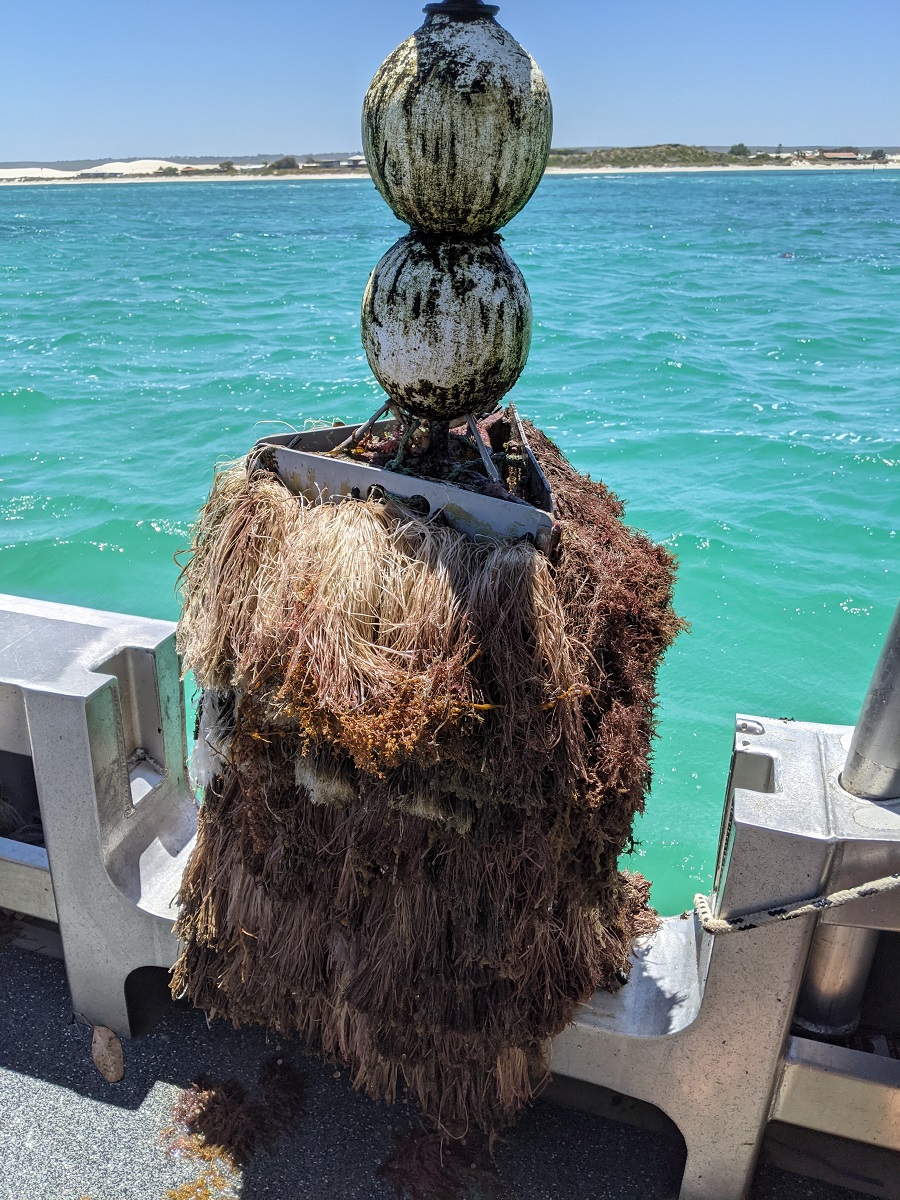
The puerulus stage of Panulirus cygnus settles naturally into areas with both reef platforms and attached algae during the dark phase of the moon (new moon period). Artificial collectors mimic the algal habitat and thus provide a mechanism that allows relative settlement rates of puerulus throughout the fishery to be measured.

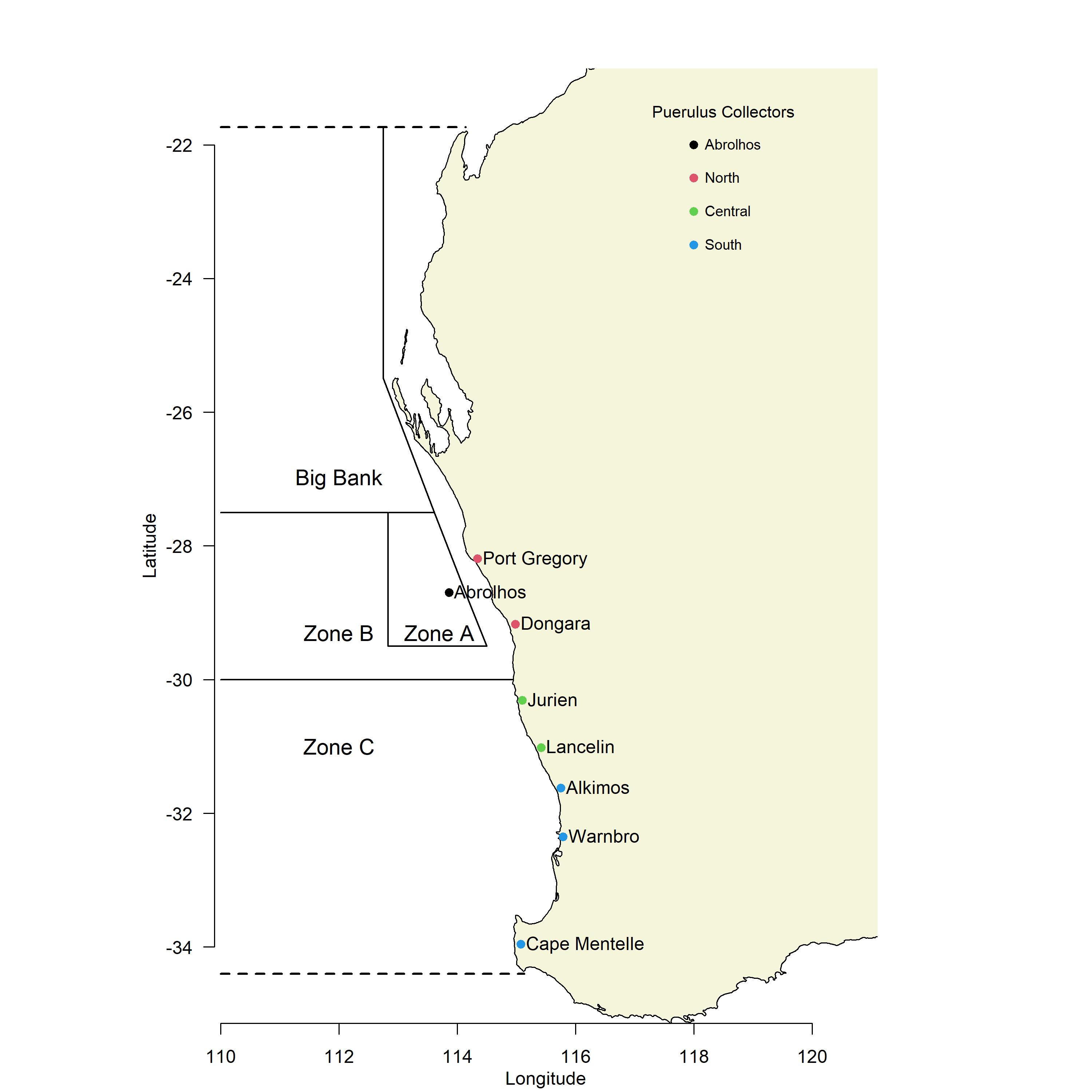
Each monitoring location (indicated on the map below) contains five or six collectors, each of which are sampled every full moon period (five days either side of the full moon) over the settlement season (May to the following April). This sample is considered representative of the settlement over the previous new moon period.

For each site a monthly average is determined based on the total number of puerulus retrieved from each collector, averaged over all the collectors sampled. In April each year a seasonal average is also determined, the sum of the monthly averages from May to April.

In cases when a location was not serviced for a given month(s), perhaps due to bad weather, an estimate of settlement is determined based on the historical proportion that month contributes to the overall catch.

Not all the lobsters settling on the collectors are early stage puerulus. Some are slightly larger, about one month old, probably after settling late in the previous month. These lobsters are added to the previous month’s settlement tally. Also in most years a new moon will occur 13 times, resulting in one month having two new moons. In these months we record the puerulus settlement twice and combine the averages of the two settlements to get a total measure for that month. These may cause the figures reported on this website to change slightly (for months with two new moons).

About the figu​res

For each area there are two sets of figures; one displays the monthly average while the other shows the cumulative average.

In both figures the grey areas represent the historical range (90 per cent confidence region) of settlement (pre -2007).  Values towards the upper edge of the grey area are expected in years when environmental conditions are favourable and values towards the lower edge when environmental conditions are not.  The environmental conditions that have historically influenced settlement include offshore water temperatures in February/March and winter/spring storms.  In recent years however the low puerulus settlement has not been explained by these environmental variables and extensive research projects are underway to try and detect the cause of the low settlement.

On the monthly average figures the vertical dotted lines represent the start and end of each settlement season (May and April).

The new moon date prior to sampling determines which month's data is shown on the graph. For example, if the new moon occurred on the 25/04/09 and sampling occurred near on the full moon in May, it is recorded as the average settlement to April on the graph.

Please note that the 2011 sample for July consisted of settlement over two new moon periods (new moons on the 1st and 31st July); we therefore combined the number of puerulus from each sample into one sample.

Historical data covering all areas

(Click the charts below to download larger versions.)


Please note: on the cumulative graph figures below only one point is present at this stage as this is the start of the new settlement.

Current data - as at 1 May 2013

Abrolhos - Rat Island


North - Dongara/P.Gregory (Seven Mile Beach)

Central - Jurien/Lancelin

South - Alkimos/Warnbro/Mentelle

(Click the charts above to download larger versions.)

Please note: At the end of the 2010/11 puerulus settlement season the puerulus graphs on the website were changed from displaying settlement at a few individual locations to averages of regional areas, eg. North area = Port Gregory and Seven Mile Beach.  The historical figures on the website were however not updated  due to a plotting error, that is they continued to display the historical levels of settlement for just an individual site (on the north graph the historical information continued to show Seven Mile settlement only, not an average between this and the Port Gregory location).  This has now been corrected with previous years now displaying the average of the locations for that area.  This has caused the levels shown in some plots to change.

Contact Mark Rossbach for further information.
T: (+61) 08 9203 0111
E: Mark.Rossbach@fish.wa.gov.au

Last modified: 1/05/2013 11:06 AM

wa.gov.au

© All contents copyright Government of Western Australia. All rights reserved. ABN: 55 689 794 77

Copyright

© This work is copyright. You may display, print or reproduce this material only in an unaltered format for your personal or non-commercial use, or for use within your organisation. Apart from any use permitted under the Copyright Act 1968, all other rights are reserved.

Disclaimer

The information and advice provided by the Department of Fisheries website is made in good faith and is from sources believed to be reliable and accurate at the time of release onto the website. Changes in circumstances after a document is placed on the website may affect the accuracy of the information. Full disclaimer details are available at www.fish.wa.gov.au.